Friday, 29 March 2019

After the field…


The fieldwork is only part of it. What good is all that data if you don’t do anything with it.  This is pretty much where I am right now. Drowning under the mountains of data I have collected over the years.

When I come back from the field I have the rather tedious task of transcribing my voice recordings and coding my videos, first onto sheets of paper so they can be added to my physical data folder and then copied into my master data sheet (which is now getting so big it often causes my laptop to crash when I open it, yes probably an indication that I need a new computer!). This is painfully slow work and easily my least favourite part of science. BUT I do understand how necessary and important it is. One of the biggest pieces of advice I can offer anyone starting out in behavioural science is keep on top of your input. There is nothing worse than having to input months and months of data all at once.

Gala is my data input and analysis buddy.

As we use Garmin GPS units at PLT I use a program called basecamp to store and organise my GPS data. I have two maps, the raw points and the adjusted points. Because I cannot always get to the exact point where the monkeys are (anyone who has ever dealt with bamboo patches in a forest or experienced “wasp season” will understand why) when I record a GPS point I record how far the monkeys are from the point and the degrees from north. This allows me to adjust my point on the computer to allow for a much more accurate picture of where the monkeys spend their time.

Our GPS unit with trail maps and monkey sightings. 
When I was at home over Christmas I spent four days in Aberdeen at my university learning from my supervisor, Dr. David Lusseau, how to use multinominal log linear models to analyse my first data set – the feeding data. This was a brand new experience for me, statistics and data analysis have never been my strongest areas and I have never used R before. It turned out to be a really enjoyable experience (although I have never suffered a headache like the one I had after those four days!). Seeing my first results after 6 years of work was really emotional, particularly with the data from Laguna Blanca. For a long time I never believed that I would get usable data from the Laguna Blanca capuchins and seeing it work (especially after the horrible way in which we lost access to that site) definitely made me bubble a couple of times.

I am now working on a publication on the diets of the capuchins across the two sites and I am so excited to hopefully share the results once this is finished!

Mate gives you a boost to get through.
When people are starting out in field biology they often forget that the “boring” or “difficult” part at the computer is just as necessary as chasing your animals around, measuring habitat variables or setting your camera traps. Without this part of the work we are unable to share our findings with the wider community – an essential part of the scientific and conservation process!

Sunday, 24 March 2019

Let’s break it down: The scientific research.


My National Geographic funded project is broken into three sections, based on the three tenets of Fundación Para La Tierra: scientific research; community engagement and education.

Let’s talk about the scientific research.

This part of my project is also the research that I have been doing for my PhD (Conservation Science) with the University of Aberdeen. I am working to determine the ecological requirements of the hooded capuchin in disturbed and pristine Paraguayan Upper Paraná Atlantic Forest. There is so much I want to know about how this incredible little species is coping with the massive scale of habitat destruction in this forest. Does the composition and size of their groups change? Does their home range size change? Do they have to alter their diet? CAN they alter diet? Do they use the space available to them differently? How does the level of habitat disturbance affect their activity budgets?

So many questions! So how do I try to answer them.

I spend 15 days per month at my field site at Nueva Gambach, with a small team of volunteers who come to help out and learn about behavioural data collection. We get up and leave the house about half an hour before the sun rises so that we can make it to the capuchins sleeping site before they wake up. Every half an hour (or when the monkeys move more than 100m) we mark a GPS locations on our GPS units. As soon as they wake up we use a technique called “scan sampling” to record the behaviour of every visible individual every minute. My focal group has 22 individuals (three adult males, six adult females, seven subadults (three females, two males and two unidentified sex), three juveniles (one male, one female and one unidentified sex) and 3 infants). This makes recording data a huge challenge. These monkeys are very active, fast moving and the habitat is dense and difficult to move through.


We use dictaphones to record behaviour as it is the only way to make sure you aren’t missing anything. Trust me, I have tried everything. The number of times I have fallen flat on my face trying to write things down on a data sheet and clipboard or looked up from writing to find the group had vanished. It has to be voice recordings!


First, we record the identity of the individual, or at least age and sex! Capuchins are not obviously sexually dimorphic and telling them apart can be tough for beginners. I tend to look for physical indicators first – the shape and size of the tufts, obvious scars (one of my subadult females is missing an eye) or if there are any clear colour differences (one of my adult males at Laguna Blanca had a big tuft of white hair sticking out the back of his black cap). Adult males and females are the easiest to tell apart. The males are big and muscular. The females are finer and have ridiculous shaped forehead tufts. I had a female called Alien in O Group at Laguna Blanca who looked like a flying saucer had landed on her forehead, and another female in F Group who looked like someone had stuck pom poms to her face. Very distinctive.  With the subadults and juveniles it’s much harder. They look very, very similar and to positively sex them you have to get a look at their genitals.

Adult male - note the big square head

Alien with her huge rectangular tuft.

Once we know who we are looking at, we record how many metres high in the tree the individual is, what it is doing and if any other individual is within 1m. If the individual is eating, we need to record what it is eating and any other useful information like how it is processing the food or if it is using one hand in preference over the other.

When the monkeys start to move things get even harder, and often even more fun. You need to try and stay with them for as long as possible. Not always easy. In fact, more often than not, very difficult. You can end up thigh deep in a swamp, trying to keep your equipment dry and continue you follow. Or on your hands and knees crawling under spiky bamboo. Or jumping into the river to get a better view. Sometimes it’s easier to skirt round the edge of the forest and try to cut them off as they head to their next feeding site. A lot of the time we lose them and have to spend hours creeping through the forest in silence, straining our ears for an alarm call.


This carries on until dusk. We try to locate the sleeping site where the monkeys will spend the night and stay with them until after dark. The days can be anything from 11 to 15 hours in the forest depending on the time of year. It is hard, physically and mentally demanding and most of all, it is wonderful. I will never be able to see it as anything less than a privilege to be allowed a glimpse into the lives of these spectacular little monkeys.


Saturday, 10 November 2018

So this changes everything.....


The 24th January 2018 was like many other days for me. It was the height of summer so I was completely melting in my heavy field clothes (including heavy leather snake guards) as I crept around the Atlantic Forest straining my ears for any sound of the capuchins over the metallic screeching of the cicadas. For most of the day we had had no luck whatsoever and while walking in silence around the forest, my mind tends to wander. That day, my mind would not stop wandering back to a grant application I had submitted the previous October. The most ambitious grant I had ever applied for. A National Geographic Society Standard Grant.

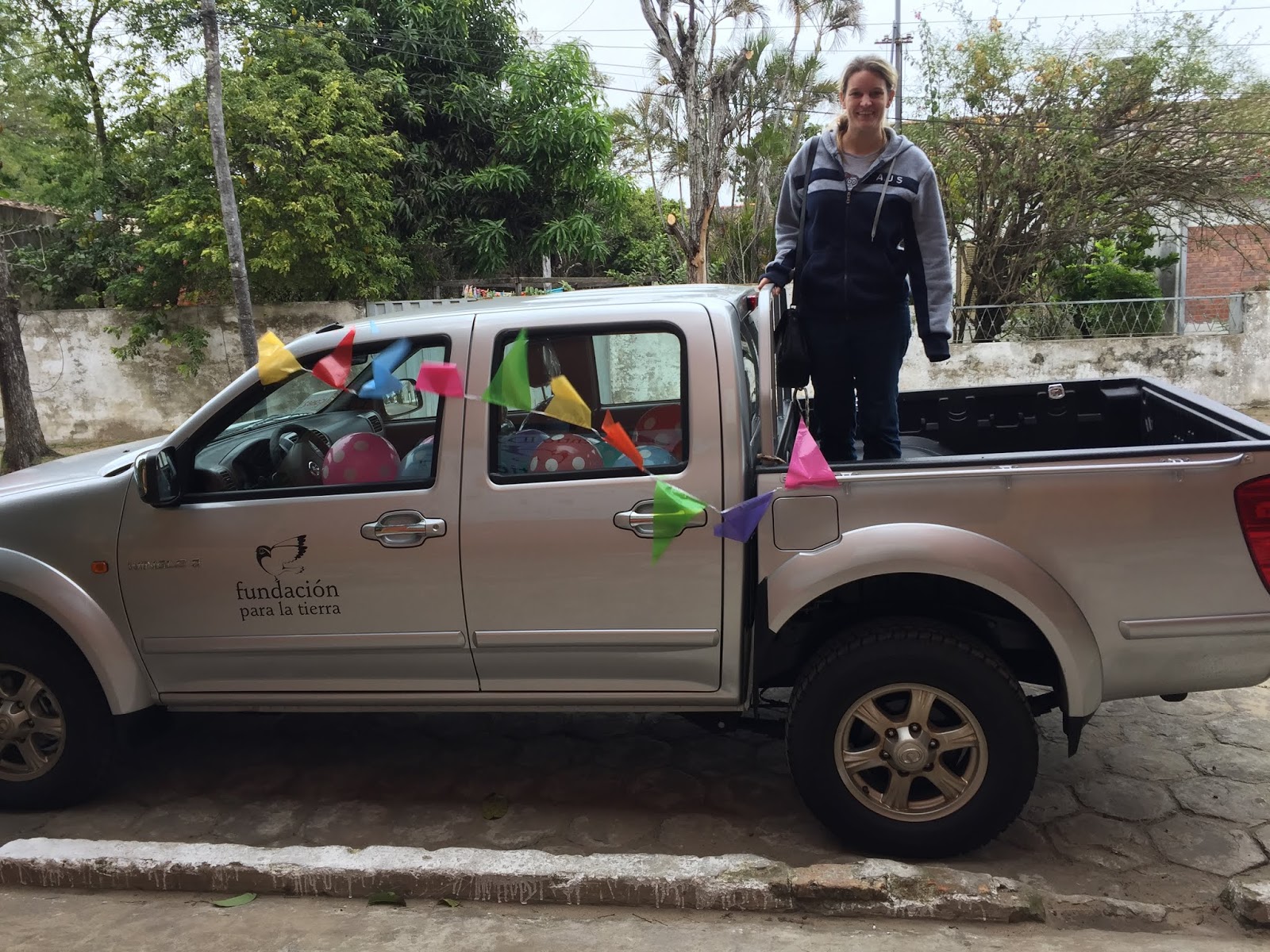
When we moved from Laguna Blanca to Pilar and PRO COSARA we still had two cars. However the ageing Hilux was reaching the end of its life and seriously struggled on the asphalt roads and the wingle was needed to facilitate the projects in Pilar. This meant that the trips to the Atlantic Forest to continue the capuchin project were done by bus. Or busES should I say. The trips weren’t pleasant. We went from Pilar and to Encarnacion where we changed to what we lovingly refer to as a “chicken bus” for the journey to Ynambu, the closest village to the reserve where we were picked up by the forest guards for the last half hour in the back of their truck down a dirt road. With all the supplies that 6 people needed for 15 days in the field.  The way back was even worse and involved sitting for 5 hours in San Ignacio on the side of the road waiting for a bus to pass for Pilar (that never had any seats left) that got us home at 1am.

It wasn’t sustainable and a better solution was needed. So I took the plunge and applied without, if I'm being honest, much hope. Fast forward to January 24th. I knew that that I would be told the outcome by the 26th but for some reason I could not stop fantasising about what it would be like to open my email and see that I had been awarded the grant. I kept pushing the thought away, confident that it would just make it more disappointing when I didn’t get it. We got back to the house about 7:30pm, two of the forest guards were drinking beer outside the airplane hanger that the live in and offered me one. I plonked myself down on the concrete beside them, accepted a beer and pulled out my phone as it buzzed in my pocket. An email had come through from National Geographic. I felt sick. I must have turned grey because the guards were staring at me.

“Dear Miss Smith: The National Geographic Society’s Committee for Research and Exploration has AWARDED you a grant….”

I started to scream and burst into tears, just about causing the two poor guards to just about have a heart attack.

But what actually is the project. The project is titled “Paradise Lost: Saving the Hooded Capuchin and Paraguayan Upper Paraná Atlantic Forest through Scientific Research and Community Engagement” and is split into three parts:

Objective 1: Determining the socioecological needs of the hooded capuchin in the Atlantic Forest.

This is the continuation of the PLT capuchin research project. As little research has been done in Paraguay important conservation decisions are often taken with little understanding of the threats facing ecosystems and result in little effective conservation action. This section of the project aims to study the ecology and behaviour of the hooded capuchin in San Rafael National Park, combine the results with PLT’s long-term dataset from Laguna Blanca and determine the ecological requirements of this species in forest fragments of different sizes and levels of degradation. Using this information I aim to create the country’s first evidence-based conservation action plan for the hooded capuchin in the Atlantic Forest.

The hooded capuchin (Sapajus cay) in Nueva Gambach, San Rafael National Park, Paraguay
 Objective 2: Primatological Training Program for Forest Guards.

This is coming soon! We will run a course for Paraguayan forest guards from all over Paraguay, teaching them primatological field techniques including VHF telemetry, camera trapping and census and survey techniques for counting primate groups in the reserves where they work. They will also receive training in environmental education techniques from the Para La Tierra Voces de la Naturaleza education team.

Teaching how to use the Biotrack Sika receiver - an invaluable tool when tracking an animal like the capuchin!
Objective 3: Inspiring a New Generation of Conservation Heroes.

Research is great. I absolutely love scientific research. But I am completely aware that successful conservation project are multidisciplinary and, as there is no silver bullet, issues need to be tackled from several different angles. The National Geographic grant allowed us to extend the primate project into the local communities and begin teaching in local primary schools. We are in the process of carrying out the three primate conservation lessons developed for the eco-clubs with the support of the International Primatological Society Lawrence Jacobsen Education Development Award (2016) in three communities that border San Rafael.

Teaching about water contamination in a school in Alto Vera.

My first lesson in Mberu Indigenous school and my first attempt at teaching in Guaraní!
This award has changed everything. We now have a new car that get us to and from the field site in 4 hours and allows us access to the communities for teaching (one of them is 120km away down rather awful dirt roads) and a new Biotrack receiver and antenna so we can collar two groups of capuchins and follow them simultaneously!!


The day the car finally came back! Thank you so much National Geographic!! There are honestly no words that are able to express my gratitude!!
I am so grateful to the National Geographic Society for taking a chance on this project and me! Obviously its now November and the primate team has all been working hard all year on this project (the biggest reason why I have been very lax a updating this blog!) but stay tuned for updates on all the the progress we have made so far, whats coming next and all the exciting doors this incredible opportunity has opened!

Sunday, 15 October 2017

What's happening with the capuchin project?

In my post “Why the Radio Silence?” I wrote that the capuchin research at Para La Tierra was continuing despite losing Laguna Blanca. PLT is collaborating with ProCosara and I would like to share a bit more about this great organisation and what we want to achieve through this collaboration.

Passionate residents and conservationists who were concerned about the rapid destruction of the Upper Paraná Atlantic Forest founded ProCosara back in 1997. The main goal of the organisation is the protection and conservation of San Rafael “National Park”. San Rafael is an incredible place and is considered by WWF as one of the 200 most important biological regions on earth. It is located in the departments of Itapúa and Caazapa. Currently San Rafael is the largest remaining tract of Atlantic Forest left in Paraguay (73,000ha) but it is privately owned and split into more than 60 different properties. Even though the area is designated to become a national park the reality is that the Paraguayan Government have never actually been able to purchase the land, so it has no formal protection.

River crossing in Urutau Trail (Photo: Josh Mays)

The lake at Nueva Gambach (Photo:Josh Mays)
ProCosara works to protect the forest through monitoring (both with a small aeroplane and with forest guards patrolling on the ground), land purchase and reforestation programs (in conjunction with WWF) and through education and promotion of sustainable land use practices in local communities. 

The ProCosara forest guards (Claudio & Victor) during a competition with the blowgun. (Photo: Margherita Rinaldi)

Teaching the guards how to use the blowgun. (Photo: Margherita Rinaldi)
For two weeks a month I take a groups of volunteers across the country to Nueva Gambach where Procosara’s field station is based. Nueva Gambach is a property belonging to Hans Hostettler and Christine Kohli de Hostettler – the founders of ProCosara. This property has 150ha of beautiful, near pristine Atlantic Forest and is located at the very southern tip of San Rafael.


When it rains the red dirt of the Atlantic Forest becomes an adventure to walk through! (Photo: Josh Mays)
The 15 days that we spend in the forest each month are tough but incredible. We get up between 4-4:30am and are out in the field before 5am. We then search the forest until dusk (12-15 hours later depending on the season) for the capuchins. The capuchins at Nueva Gambach are not full habituated, they are not even nearly as habituated as the monkeys I left behind at Laguna Blanca and they can be very hard to find. However, when we do find them we get to see some pretty exciting things, in my first week I got to see the hilarious solicitation behaviour of the females – something that took me nearly 4 years to see in Laguna Blanca.


The first time the volunteers crossed the river!

After the rain is great fun in the forest! (Photo: Marco Alesci)

The first ever Procosara volunteer group May/June 2017 (Photo: Josh Mays)

Walking past the lake to the forest Photo: Margherita Rinaldi)
Our first priorities at Nueva Gambach are to establish how many groups live in on the property and determine group demographics (we already have the feeding platform up and baited with a camera trap) and start to get an idea of where the different groups spend most of their time. In the long-term the plan is to combine this data with that collect at Laguna Blanca. This will hopefully provide a fuller understanding of the ecological needs of this species and allow development of a conservation strategy that will, in turn, help protect their habitat - the Atlantic Forest.


The forest guards putting up the feeding platform.

Adult male capuchin posing for the camera at their favourite sleeping site. This is by far the best place in the forest to see them and they seem to spend the night there every few days.

Capuchin munching on pine cones in the pine plantation on the edge of the forest. The capuchins slept in the pine plantation a lot during the winter months.

Exploring up the river.