Friday, 29 September 2017

Let's talk howlers.


Howlers are very curious.

Since Para La Tierra moved fully to Pilar in May this year one of the interesting new opportunities this opened up for us the chance to study the Black-&-Gold (or Paraguayan) Howler monkey (Alouatta caraya). The city of Pilar and the properties surrounding the city are absolutely full of these large, noisy primates.


But running away from people is just far too much effort for them.

Howler monkeys are the largest primate species in Paraguay with adult males weighing 5.3-9.6kg! They are not only sexually dimorphic in size but also colour: the adult males are all black while the adult females are yellow. Much easier to tell apart than the capuchin monkeys! As the name suggest, they are very, very loud. The most striking difference for me after nearly five years studying capuchins is their complete lack of fear of people. I have studied wild howler monkeys before, the mantled howler (Alouatta palliata) in Panama back in 2012 but after so long chasing after the capuchins as they vanish off into the dense Atlantic Forest, I admit I had forgotten what it is like to find a new monkey group, and not have them run away!


A very old female in Santa Ana
The sheer number of howlers both inside and outside the city, how easy they are to find, and the fact that they can be watched all day all leads to a very exciting conclusion: the possibilities for research are endless!! Currently working at PLT are Marco Alesci (Itlay) and Sara Bethel (USA). Marco is carrying out his data collection for his Masters evaluating the attitudes of the people of Pilar towards the urban monkeys and the dangers that these monkeys face living in such an unnatural environment. Sara is just about to finish a full site census of Santa Ana, a ranch just outside Pilar, where she has identified more than 12 separate groups of howlers.

Marco Alesci studies human/howler conflict and interactions in Pilar.
Sara Bethel carried out a full census of howlers in the Humid Chaco at Santa Ana Ranch.

Until now almost no work has been done on this species in Paraguay, and nothing has been published about the behaviour or ecology of the urban howler population in Pilar.  Some potential project ideas include determining the home range and daily path lengths of the urban groups, looking at behavioural differences between urban and forest groups, dietary diversity of the urban groups or establishing dominance hierarchies.  

Adult male roaring.
These are just some of the possibilities. Undertaking an internship with PLT means that you have the chance to plan your own project according to your own research interests. There are so many howler monkeys in Pilar that we need help ASAP to be able to collect data on them all! If primatology appeals to you and you want to get up close and personal with these fascinating creatures (in a country most people never get to visit) why are you hesitating! Contact Karina Atkinson (paralatierra.py@gmail.com) to apply for a position with our primate research team.


The howler monkeys and adventure awaits!

Monday, 25 September 2017

Why the Radio Silence?

So after nearly 10 months of no activity i am finally ready to restart this blog. Some people reading this know the reason for the radio silence. Over the last year my colleagues and I at PLT got a rather rude awakening to the darker side of life as a conservationist. I will give a very brief account of what is a pretty depressing story. 

Since 2010 PLT had operated out of Reserva Natural Laguna Blanca in San Pedro, Paraguay. Our goal was (and still is) to conserve Paraguay’s natural habitat using a combination of scientific research, community engagement and education of international volunteers and interns. This is not always an easy life to live - you are far from your family, you miss birthdays, weddings, births and funerals and you don’t earn a lot of money. However we all do this because we believe it is important and we want to make a difference and we know it is worth the sacrifices we make. 

Laguna Blanca (January 2013)
In October last year the administration of Laguna Blanca changed and for the next six months we tried our hardest to carry on as normal in spite of our lives being made increasingly difficult. Unfortunately the situation became unliveable and on May 1st, Karina, Jorge and I packed the car for the final time and drove away from what had been our home. It wasn’t without its casualties. We were forced to leave behind our museum collection - the biggest in the country from a single site and an invaluable scientific resource. And for me personally, I had to say goodbye to the capuchins I had spent more than four years habituating.  Devastating doesn’t really begin to cover it. 

O Group juvenile (April 2017)


Laguna Blanca (January 2013)

However I’m sure we are not the first and wont be the last conservationists to have the rug pulled from under us and we might be bruised but we are certainly not broken.  

Thanks to an incredibly generous donation from the late Don Julio Contreras - a very impressive Argentinian biologist, we now own a beautiful house in the city of Pilar. And thanks to the generous people who donated to our end of year fundraiser we were able to transform this house into a scientific education wonderland that accommodates our new ecoclub project, our volunteer and intern program, a space for our new museum and a lab.  In regards to primatology there are lots of exciting new opportunities. Pilar is crawling with black and gold howler monkeys - every patch of trees in the town appears to have its own group! 


Black and Gold Howler monkeys at Santa Ana - a property in the humid Chaco just outside Pilar.

And the capuchin research continues! We have partnered with Procosara, a wonderful organisation dedicated to protecting San Rafael, the largest Atlantic Forest fragment left in Paraguay. Two weeks a month I take groups of volunteers out to Procosara where we spend 12 hours a day exploring this incredible forest.  The recent past may be dark but the future of PLT is looking bright. I have been in serious denial about what happened at Laguna Blanca but I’m now ready to take these lessons and use them going forward. I feel like I now understand the real issues conservationists can face and it isn’t the lack of good cheese, avocados or a fast broadband connection! 


Spot-billed toucanet at Procosara
Capuchin monkey eating pine cones at Procosara

So goodbye Laguna Blanca, O Group and F Group. It was an amazing four years. Ok future; let’s see what you've got.


Tuesday, 6 December 2016

Testimonies from the Field

One of the great things about running the Para La Tierra Primate Project is that I get the chance to share my project with international volunteers and interns and let them experience what being a field primatologist is really like. Capuchins start their day with the sun, which means that we need to be under the tree they slept in before dawn. Our house is a 30-minute walk from the forest, which means that we have to leave at 4:30am. We then spend 9-12 hours walking/running/crawling around the Atlantic Forest to keep up with or find the capuchins. Getting the chance to spend your days in one of the world’s most endangered terrestrial habitats is nothing short of a privilege. The more time you spend in the forest, the more likely you are to run into some of the other mammalian inhabitants including howler monkeys (if you are really lucky!), coatis, crab-eating foxes, tayras, jaguarundis, oncillas or peccaries. And of course the capuchins themselves are a constant source of entertainment.


Here are some testimonies from some past and present members of the primate team:


“My time at Para La Tierra….hmmm, how to describe it? Amazing, wonderful, exciting, stunning, exhilarating, shocking, beautiful, hard-work, fulfilling and so many other words that I could probably just fill this whole space with! I volunteered with Para La Tierra from August 2013 until February 2014. I was a part of the primate project run by the lovely Becca Smith. The main aim of why I was there was to help collect valuable data relating to the Azara’s capuchin species (Sapagus cay) that are found at Reserva Natural Laguna Blanca. We would go out, every day, to the forest in search of these amazing monkeys to observe their behaviour and collect any other data we could about them. This would include the type of food items they were seen to be eating, their sleeping sites, we took photos to build an archive of individuals and so much more. Now, I’m not saying this was a walk in the park and we found them every single day and just got to sit there and watch the beautiful monkeys. This was definitely hard work trying to find the groups and then stay with them as we tried to document their behaviour but I will tell you this, the first moment (and every moment after that) you see these amazing creatures in the wild, every early start and all that comes after it is, without a doubt, is 100% worth it….trust me. Throughout my time as a volunteer I was able to develop new field work skills and had the opportunity to help develop and test new projects or ideas. If you are someone that has never done fieldwork before, don’t worry, this is a great program to join to teach you valuable research skills that can really help if you plan to do any type of fieldwork in the future or even with university. You will get to see so many other animals too while you are there. There are amazing reptiles, birds, and of course the other furry mammals that are around. On a bit of a road-trip that we took to the Chaco region in the north of the country I was lucky enough to see a wild capybara, some flamingos and wild pigs! I absolutely loved every single minute of my time in the field but that wasn’t the only experience that I gained volunteering with the Primate Project….oh no! Visiting Paraguay, I was able to experience the beautiful and wonderful Paraguayan culture. The people there are so generous and welcoming. I even learned some Spanish along the way – I thought I was crap with languages, so if I can pick up some then I think anyone could! To some up my experience – I went as a volunteer but left having met some absolutely amazing people along the way (many I’m still really good friends with, even if they live half-way across the world), learned something about other people/cultures as well as myself, developed new skills and even got to say that, in some small way I was able to contribute to the research that is fighting to understand and save these amazing capuchins and the habitat that they live in. “ Anna O’Riordan, 2013/2014

“I interned with PLT in 2014 and returned as a primate team volunteer in 2015. I originally went to Laguna Blanca to complete an intern project on trapping small mammals. However, the crab-eating foxes in the Atlantic Forest soon learned that they could pull my Sherman traps off of the trail and flip them over to retrieve the tasty bait inside. I spent most days during my internship in the forest tracking down my lost traps - which gave me the perfect opportunities to learn how to follow the capuchins. I returned to Paraguay a year later and helped Becca complete a demographic assessment of one of the capuchin groups using a camera trap. We were fortunate enough to have recently published our study in the journal Neotropical Primates and present our findings at an International Primatological Society conference this past August. One of the best experiences as a primate volunteer was when Becca and I were able to watch group O for more than a half-hour on the day before my 22nd birthday and then saw two crab-eating foxes and a jaguarundi on our walk back from the forest. Since my last visit to Laguna Blanca, I completed my Masters degree in biology and I am currently a full time laboratory assistant at the California National Primate Research Center in the US. I am hoping to eventually enroll in Ph.D.program that would enable me to study the primates of the Argentinian and Paraguayan Chaco.” Emily Briggs, 2014/2015


“I was always the child that would spend endless hours outside looking at every piece of grass and approaching every moving thing I encountered. I’m that kind of person that, while being at a party, spends more time with the dog than with the actual people at the party! I couldn’t have been happier than walking around in the forest looking for the capuchins. In the Netherlands we have a saying; like a fish in the water (we have more strange proverbs, but I will keep it short). I won’t lie, this kind of fieldwork is though. But it is more than rewarding to find a group and actually observe their behaviour, or even interact with you in person! It is more than rewarding to take volunteers to see the capuchins and their face lit up when the capuchins come closer and closer. And it is priceless to be told by them that a lot of people would probably want to see this in real life. I cannot agree more; everyone should see this for themselves. I am inviting each and every one of you to come and be amazed by these adorable, clever, fascinating little creatures. See you at Laguna Blanca! Kelly Rebergen, 2016

“I decided to come to Para La Tierra for many reasons, all of which made the organisation stick out above others. I had been looking at a multitude of conservation-based projects situated all around the world but in the end chose PLT. PLT offered a place where I could progress in my academic career, engage my passions and interests and have a completely new experience. I was particularly drawn to the academic aspect here, which goes above many other conservation organization, allowing you to create or join an existing research project associated with your area of interest. I am also deciding what to do with my future and whether or not to progress my studies with a PhD and feel my time at PLT has definitely fostered these thoughts. I think its safe to say my favourite moment at PLT so far has been when we found the black and gold howler monkeys! It had been three years since they had been spotted and we were able to observe them for a couple hours over two days. We were also lucky enough (or not) to be showered by howler monkey poop and urine, which definitely made it a moment I will never forget. However, it’s also just as exciting when we find the capuchins in the forest, every time I see them I feel so privileged and amazed to be observing and studying them in the wild. Its extremely tiring being in the field researching the capuchins but I can’t wait to see what the next month will bring.” Bella Contador-Kelsall, 2016


We have spaces right now for Primate Team interns from January until April 2017 on a study of the dietary diversity of the three capuchin groups. We are also looking for people to come and help us track our incredibly elusive howler monkey group! If you are up for the challenge and want to contribute to primate research and conservation in Paraguay, please email your CV to Karina Atkinson at karina@paralatierra.org.


Hope to see you soon in Paraguay!

Thursday, 1 December 2016

URGENT: Primate Team Intern opportunities available in January!

The PLT Primate Team is looking for dedicated individuals to join us from January -April 2017 to participate in two studies of Laguna Blanca's three groups of hooded capuchins. The first study is investigating the dietary diversity of the different capuchin groups and how they vary across seasons. This project has been running since early 2016 and we want to collect a full years worth of data to compare how the composition of their diets change across the seasons. The second project is looking at forest strata use by the groups. We are looking for three interns per project to start as soon as possible!

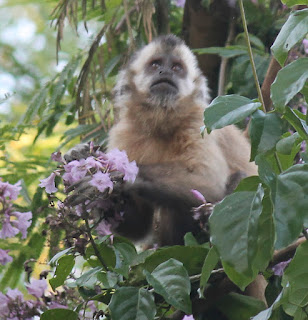
Juvenile Capuchin eating flowers.
Interns spend full days in the field searching for, and following the capuchins and data is collected through focal follows and scan sample methods. Sample of fruit are collected for identification and photographing and we also recorded what processing technique the monkeys are using and what height they are in the tree while feeding.

Subadult capuchin eating insect galls from leaves and engaging in "leaf-sniffing" behaviour.
This is an excellent opportunity for someone preparing for further study in primatology or wild animal behaviour. This program will give you first-hand experience of life on a research station as you explore little known habitats and learn the skills you need to progress in your biology career. You will gain experience in VHF tracking and observing wild primates in their natural habitat, data collection and use of GPS and mapping software. There may also be the opportunity to assist in writing scientific publications.

New baby in O Group clings to Gizmo's back while she eating Caraya-Bolas fruit.
We are looking for people to start next month (or even sooner if you would like to spend Christmas and New Year on a white sand beach in Laguna Blanca!). Please share this opportunity with your friends and if you are interested contact Karina Atkinson on karina@paralatierra.org. 

Eating papaya fruit on the side of the road.

Hope to see you soon in Paraguay!!!